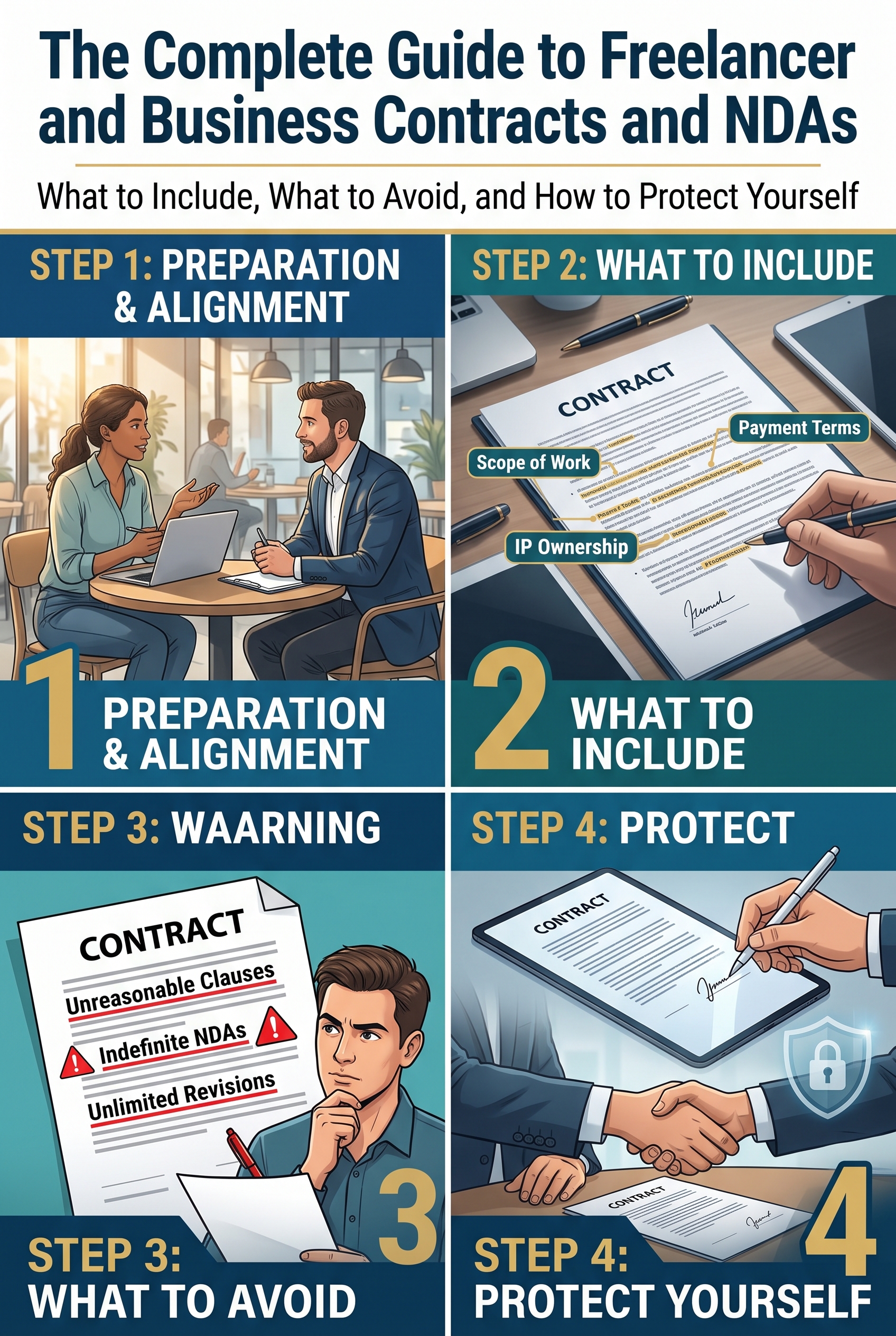
The Complete Guide to Freelancer and Business Contracts and NDAs
What to Include, What to Avoid, and How to Protect Yourself
Almost every freelancer or small business owner has a story about a project that went sideways. A client who disappeared after receiving the final files. A “quick revision” that turned into twelve rounds of changes. A payment that was promised “next week” for three months straight. Very often, these stories share one root cause: nothing was put in writing, or what was written was too vague to help.
A good contract does not make you look distrustful. It does the opposite. It shows that you take the work seriously, that you respect the other person’s time and money, and that you would rather solve problems on paper than in an argument. A well-drafted non-disclosure agreement (NDA) does something similar for sensitive information: it tells everyone involved what must stay private and what happens if it does not.
This guide explains, in plain language, how freelancer contracts, business service agreements and NDAs work. You will learn what makes an agreement valid, which clauses really matter, which mistakes cause the most trouble, and how to draft and sign documents with confidence. Whether you are a first-time freelancer, a small agency owner or a business hiring outside help, you should finish this article knowing exactly what to look for.
Note: This article is for general educational purposes. Contract law differs from country to country and even from region to region, so it is not a substitute for advice from a qualified lawyer in your area.
Why a Written Contract Matters More Than You Think
Many people believe a handshake or a friendly email thread is enough, especially when working with someone they like. In practice, friendly relationships are exactly where misunderstandings hide, because nobody wants to awkwardly ask the hard questions up front.
A written contract does four jobs at once.
It creates a shared understanding. When you and a client describe the same project in your heads, the two descriptions are rarely identical. One person imagines a five-page website, the other imagines fifteen. Writing the scope down forces both sides to compare their expectations before any work begins.
It protects your payment. A contract states how much you will be paid, when, and in what way. If a client later refuses to pay, a signed agreement is the strongest evidence you can bring to a conversation, a mediator or a court.
It protects your ideas and your reputation. Clauses about ownership, credit and confidentiality make clear who can use the finished work and what each party may say about the other.
It gives you an exit plan. Projects get cancelled, businesses change direction and people fall out. A termination clause explains how to end the relationship fairly, what happens to unfinished work and who owes what.
Think of a contract as a map drawn before a journey. You hope you will never need to consult it urgently, but if the road gets rough, you will be very glad it exists.
The Building Blocks: What Makes a Contract Valid?
You do not need fancy language to make an agreement legally meaningful. In most legal systems, a contract has a handful of basic ingredients.
Offer and acceptance. One party proposes terms (“I will design your logo for this price”) and the other agrees to them. Acceptance must match the offer. If the client replies “yes, but I want the source files too,” that is a counter-offer, not acceptance, and the discussion continues.
Consideration. Each side gives something of value. Usually that means services in exchange for money, but it can also be goods, rights or other promises. An agreement where only one side gives anything is generally harder to enforce.
Intention to create legal relations. Both sides must understand that they are making a binding commitment, not just chatting about possibilities. A phrase like “this agreement is legally binding” helps remove doubt.
Capacity. The people involved must be legally able to enter contracts. Usually this means being of legal age and of sound mind. If you are signing for a company, you must have authority to bind that company.
Legality. The purpose of the contract must be lawful. An agreement to do something illegal is unenforceable, no matter how carefully it is written.
Clarity. Courts generally struggle to enforce terms that are hopelessly vague. A sentence such as “the freelancer will deliver good work soon” gives a judge almost nothing to measure. “The freelancer will deliver five finished blog articles of approximately 1,200 words each by 30 June” does.
Many places also accept electronic signatures and agreements made by email or online forms, as long as the basic ingredients are present and both sides clearly agreed. Still, always check the rules where you and your client are based, especially for contracts involving property, long-term commitments or large sums.
Anatomy of a Strong Freelancer Contract
Most good freelance agreements are built from the same set of clauses. You can adjust the wording for your trade, but the topics below are worth covering almost every time.
The Parties
Start by identifying exactly who is making the agreement. Include full legal names, business names if relevant, addresses and contact details. This sounds basic, but it matters. If your client says “ABC Marketing” but the legal company is “ABC Marketing Solutions Limited,” you need to know which one is responsible for paying you.
If you operate as a sole proprietor, use your own name. If you have a registered company, use that. Being consistent protects you in invoices, tax records and disputes.
Scope of Work
This is the heart of the contract, and it is where most conflicts begin. Describe in specific terms what you will do. List the services, the deliverables and the formats. For a web developer, that might include the number of pages, required features, browsers or devices supported and whether content entry is included. For a writer, it could be the number of articles, word counts, research requirements and whether images or SEO work are part of the deal.
Equally important, state what is not included. A short “out of scope” list prevents surprises. Hosting setup, ongoing maintenance, social media posting or additional languages are typical items that clients assume are included unless told otherwise.
Timeline and Milestones
Give dates, not just feelings. Specify the start date, key milestones and the final delivery date. Also define what each side must do for the schedule to work. If you need the client’s logo, content or feedback within a certain number of days, say so, and add that delays on their side may push back the deadline.
Breaking larger projects into milestones makes progress visible and payment fairer. Both parties can see what has been finished and what is still pending.
Fees and Payment Terms
Money clauses should leave no room for guessing. Cover the following points.
- The total price or rate. Fixed fee, hourly rate, daily rate or retainer.
- The payment schedule. For example, 40 percent upfront, 30 percent at the midpoint and 30 percent on delivery.
- Due dates. “Payable within 14 days of invoice” is clearer than “payable promptly.”
- Accepted payment methods. Bank transfer, online payment platforms or other methods, along with who pays transaction fees.
- Late payment consequences. A small late fee or the right to pause work until payment arrives.
- Expenses. Who pays for stock images, fonts, plugins, travel or software licences.
- Taxes. Whether prices include or exclude applicable taxes.
An upfront deposit is one of the most effective protections a freelancer has. It filters out unserious clients and gives you some security before you invest your time.
Revisions and Feedback
Unlimited revisions are the quiet enemy of freelance profit. Decide how many rounds of changes are included in the price, what counts as a revision and what counts as a new request. For example, adjusting colours in a design is a revision; deciding to change the entire concept after approval is a change in scope that may carry an extra fee.
It also helps to set a feedback window. Something like “the client will provide consolidated feedback within five business days of each delivery” keeps projects moving and prevents endless waiting.
Change Requests
Projects evolve. A client may add a feature, a new page or an extra deliverable halfway through. Rather than pretending this will not happen, include a simple process: the client submits the request in writing, the freelancer responds with the effect on price and timeline, and work on the new item begins only after approval. This protects you from “scope creep” and protects the client from surprise bills.
Intellectual Property and Ownership
Who owns the final work? The answer depends on the contract and on local law, and it is often not what people assume. In many legal systems, a freelancer remains the owner of what they create unless the contract says otherwise, while an employee’s work usually belongs to the employer. If you are a client, do not assume you automatically own everything you paid for. If you are a freelancer, do not assume you can reuse everything you made.
Common arrangements include:
- Full transfer of rights to the client once payment is complete.
- A licence to use the work, with the freelancer retaining ownership.
- A split, where the client owns the final deliverables and the freelancer keeps their tools, templates, code libraries or general know-how.
Many freelancers tie the transfer of rights to full payment. Until the invoice is settled, the client has permission to review the work but not to publish or use it commercially. Also consider portfolio rights: freelancers often want to show completed work in their portfolio, and clients may agree to this unless the project is confidential.
If you use third-party material such as stock photos, fonts or open-source code, mention how it is licensed so nobody is blindsided later.
Confidentiality
Even if you also sign a separate NDA, it is smart to include a short confidentiality clause in the main contract. It should say that each party will keep the other’s non-public business information private and use it only for the project. We will look at this in much more detail in the NDA section below.
Independent Contractor Status
For freelancers, the contract should make clear that you are an independent contractor and not an employee. You choose how, when and where you work, you supply your own equipment and you are responsible for your own taxes and insurance. Getting this right matters for both sides, because in many countries authorities look at the actual working relationship, not just the label on the contract. If a “freelancer” works fixed hours, under close supervision and only for one company, a tax office or labour authority may treat them as an employee regardless of what the paperwork says.
Warranties and Responsibilities
Each side promises certain things. A freelancer might state that the work will be original, that they have the right to deliver it and that it will not knowingly infringe anyone else’s rights. A client might promise that any material they provide, such as text, images or brand assets, is theirs to use. These statements allocate responsibility when something goes wrong, for example if a copyright complaint arrives later.
Limitation of Liability
Freelancers often work for fees that are small compared with the potential damage a mistake could cause. A limitation of liability clause usually caps what you can be required to pay at the total fees for the project and excludes indirect losses such as lost profits. Without it, a modest project could, in theory, expose you to unlimited claims. Keep in mind that laws in many places restrict how far liability can be limited, especially for personal injury, fraud or gross negligence, so this clause cannot remove all responsibility.
Termination
Explain how either party can end the agreement. Typical provisions include:
- A notice period, such as seven or fourteen days in writing.
- The right to terminate immediately if the other side seriously breaches the contract and fails to fix the problem after notice.
- Payment for work completed up to the termination date.
- What happens to deposits, which are often non-refundable once work has started.
- Return or deletion of confidential materials.
A fair termination clause treats both sides with respect. It does not trap a client in a project that is clearly failing, and it does not allow them to walk away without paying for finished work.
Dispute Resolution and Governing Law
Disagreements are easier to handle if you have already agreed how to handle them. Many contracts start with a friendly step, such as a meeting or call within a set number of days, then move to mediation or arbitration, and only afterwards to court. The clause should also state which country or region’s law applies and where legal proceedings would take place. This is particularly important when you work with clients across borders, because the rules, costs and practicalities can differ enormously.
Entire Agreement and Amendments
This clause states that the written contract is the full agreement and replaces earlier conversations, and that any later changes must be made in writing and agreed by both sides. It prevents the “but you told me on the phone” argument.
Signatures and Date
Finish with signature blocks for both parties, including printed names, titles if signing for a company and the date. Keep a copy of the final signed version in a safe place.
Common Mistakes People Make in Freelance and Business Contracts
Even people who use contracts regularly fall into the same traps. Watch out for these.
Starting work before signing. Excitement and deadline pressure push people to begin “just to get going.” If the deal collapses, you have nothing to stand on. Make it a personal rule: no signature, no start.
Copying a template without reading it. Templates are a useful starting point, but a contract written for a photographer will not suit a software developer. Remove clauses that do not apply and add the ones that do.
Vague deliverables. Phrases like “as needed,” “reasonable changes” or “ongoing support” mean different things to different people. Replace them with numbers, dates and lists.
Ignoring who owns the work. Silence on intellectual property leaves room for painful disputes later, particularly if the work becomes valuable.
No payment protection. Working entirely on credit, with payment only after delivery, puts all the risk on you. Deposits, milestones and late-fee clauses balance that risk.
Forgetting termination. Few people enjoy planning for the end of a relationship at its beginning, yet this is exactly when everyone is calm and cooperative.
Relying only on chat messages. Instant messages and voice notes are easy to lose and easy to misunderstand. If something important is agreed in conversation, follow up with an email summarising it, or better, update the contract.
Signing under pressure. If a client says “just sign it, it’s standard,” slow down. Standard documents can still contain unfair terms.
Understanding Non-Disclosure Agreements (NDAs)
A non-disclosure agreement, sometimes called a confidentiality agreement, is a contract in which one or more parties promise not to share specified information with anyone else. NDAs are used when business ideas, customer lists, source code, designs, financial figures or strategies are shared with people outside the company, such as freelancers, consultants, potential investors, suppliers or partners.
Imagine you run a small company that has built a new mobile app. Before you invite a freelance designer to work on the interface, you want to be sure that your unreleased features will not appear in a competitor’s product next month. An NDA gives you a clear, written promise and a legal basis to act if that promise is broken.
Types of NDAs
Unilateral (one-way) NDA. Only one party discloses confidential information and the other receives it. This is common when a business hires a freelancer or shares a plan with a prospective supplier.
Mutual (two-way) NDA. Both parties share confidential information and both are bound to protect it. This suits joint ventures, partnership talks and situations where each side will reveal sensitive details.
Multilateral NDA. Three or more parties are involved, and at least one discloses information. Instead of signing several separate agreements, everyone signs one document.
Choosing the right type avoids unnecessary friction. Asking a client to sign a mutual NDA when only you will receive confidential material, or asking a freelancer to sign a strict one-way NDA when you will also see their proprietary methods, can create awkwardness and sometimes unfairness.
Key Clauses Every NDA Should Contain
Definition of confidential information. This is the most important section. It should explain what counts as confidential, such as business plans, customer data, pricing, source code, designs, marketing strategies and trade secrets. Some NDAs use a broad definition (“all non-public information shared in connection with the project”), while others list categories. A definition that is too narrow leaves gaps; one that is too broad may be hard to enforce and can scare off the other party.
Exclusions. Good NDAs say what is not confidential. The standard exclusions are information that is already public through no fault of the receiving party, information the receiving party already knew legitimately before the disclosure, information obtained from a third party who was free to share it, and information developed independently without using the confidential material. Disclosures required by law or court order are also usually handled separately.
3. Purpose. State why the information is being shared, for example “to evaluate and deliver website development services.” The receiving party may use the information only for that purpose. Without this limit, someone might argue they were free to use the information for other things as long as they did not tell anyone.
Obligations of the receiving party. Spell out what they must do: keep the information secret, protect it with at least the same care they use for their own sensitive material, limit access to people who genuinely need it and ensure those people are also bound by confidentiality.
Duration. How long does the duty last? Some NDAs run for a fixed number of years after the agreement ends, commonly two to five. Trade secrets may be protected for longer, or for as long as they remain secret. Indefinite NDAs for all information can be difficult to enforce in some places, so a reasonable time limit often works better.
Return or destruction of materials. When the project ends, or when the disclosing party asks, the recipient should return or delete confidential documents, files and copies, and confirm they have done so.
Remedies. The clause can explain what happens if the NDA is breached. Many agreements allow the disclosing party to seek an injunction, which is a court order to stop further disclosure, in addition to claiming damages. Because financial compensation is often not enough once a secret is out, injunction rights are especially valuable.
Governing law and jurisdiction. As with any contract, say which law applies and where disputes will be handled.
No licence or ownership transfer. The NDA should make clear that sharing information does not give the recipient ownership of it or any right to use it beyond the stated purpose.
What an NDA Cannot Do
NDAs are powerful but not unlimited, and understanding their boundaries keeps you from relying on them too heavily.
First, an NDA cannot protect information that is not actually secret. If something is common knowledge or openly published, a confidentiality promise will not change that.
Second, an NDA cannot be used to hide illegal activity. In many jurisdictions, clauses that try to silence people from reporting crime, harassment, safety violations or misconduct to the proper authorities are unenforceable, and in some places they are restricted by law. The rules for workplace NDAs in particular have been tightened in several countries, so employers should be careful.
Third, an NDA cannot stop someone from using their general skills and experience. A designer who learns a new technique while working on your project is allowed to use that skill for other clients. Only the confidential details are protected.
Fourth, it cannot guarantee perfect secrecy. It gives you a legal remedy after a breach, but it cannot physically prevent a leak. For genuinely critical information, combine legal protection with practical measures such as limited access, password protection, secure file sharing and sharing only what is necessary.
Practical Tips for Using NDAs Wisely
- Share on a need-to-know basis. Even with a signed NDA, there is no reason to hand over your entire business plan if the freelancer only needs one section.
- Label sensitive documents. Marking files as “Confidential” is not always required, but it removes any doubt about their status.
- Keep records. Note what was shared, when and with whom. This helps if a dispute arises.
- Match the NDA to the stage. Early conversations might only require a short mutual NDA, while a deep technical collaboration may call for something more detailed.
- Be reasonable. An NDA that tries to forbid someone from working in their entire field for years, or that treats every possible fact as secret, can be seen as unfair and may not hold up.
- If you receive an NDA, read it. Make sure you can realistically comply with its terms, especially around storage, sharing with team members and deletion.
Other Common Business Agreements Worth Knowing
Freelancer contracts and NDAs are only part of the picture. If you run or plan to grow a business, you will encounter several other agreement types.
Service agreements. Similar to freelance contracts but often used between businesses, for example when an agency provides ongoing marketing services. They typically include service levels, reporting duties and renewal terms.
Independent contractor agreements. These are used when a company engages an individual for specialised work. They focus heavily on the contractor’s independent status, ownership of work product and confidentiality.
Master services agreements (MSAs). When two businesses expect to work together repeatedly, an MSA sets the general terms once. Each new project is then covered by a short statement of work that lists the specific scope, price and timeline, which saves time on future deals.
Partnership or joint venture agreements. These outline how partners share profits, make decisions, contribute resources and handle exits. Skipping this document is one of the most common causes of painful business breakups.
Non-compete and non-solicitation agreements. These restrict someone from working with competitors or taking clients or staff for a period. Their enforceability varies widely: some places strictly limit them, others allow them if they are reasonable in time, geography and scope.
Terms and conditions and privacy policies. If you run a website or sell online, these public documents set the rules for customers and explain how you handle personal data. Depending on where your visitors live, privacy laws may require specific disclosures.
Step-by-Step: How to Draft and Finalise a Contract
If you are not sure where to begin, follow this practical process.
Step 1: Clarify the deal in plain words. Before writing any legal language, jot down what you are promising and what you expect in return. Who does what, by when, for how much?
Step 2: Choose a solid starting point. Use a reputable template, a sample from a professional association in your field or a draft prepared by a lawyer that you can reuse. Avoid copying text blindly from random websites.
Step 3: Customise the details. Fill in names, scope, dates, prices and special conditions. Delete clauses that do not apply, and add any that reflect the unique risks of the project.
Step 4: Write in plain language. You do not need to sound like an old law book. Short, clear sentences make a contract easier to follow and, in many cases, easier to enforce. If you would struggle to explain a clause to a friend, simplify it.
Step 5: Review it together. Walk the client through the main points. Explain why certain clauses exist. A client who understands the document is less likely to dispute it later.
Step 6: Negotiate fairly. Contracts are rarely perfect on the first draft. Be open to reasonable changes, but know your non-negotiables, such as deposits, ownership terms or payment deadlines.
Step 7: Sign and store. Use a handwritten or recognised electronic signature, make sure both sides receive a copy and store the signed version securely along with related emails and invoices.
Step 8: Follow it. A contract helps only if you stick to it. If you want to change something, document the change in writing.
Red Flags to Look For Before You Sign
Sometimes the most valuable skill is noticing what feels off. Pause and ask questions if you see any of the following.
- Payment terms that are missing, extremely delayed or dependent on vague conditions, such as “payment after the client is satisfied.”
- Unlimited revisions or open-ended scope, especially for a fixed fee.
- Full transfer of rights before payment, or rights far broader than the project requires.
- One-sided termination rights, where only the client can cancel and you receive nothing for the work already done.
- Overly broad non-compete or exclusivity terms that would stop you from taking other work.
- Unlimited liability for a low-fee project.
- Pressure to sign immediately or refusal to allow any changes.
- Requests for unpaid “test work” that looks suspiciously like the real project.
- Unclear identity of the client, such as no legal name, no address or inconsistent contact details.
A single red flag does not always mean you should walk away, but it should lead to a conversation. A professional client will usually be glad to clarify or adjust. A client who becomes defensive when you politely ask for clear terms is giving you valuable information.
Digital Signatures, Online Tools and Record Keeping
Remote work has made electronic signing normal. In many countries, electronic signatures are legally recognised for most commercial agreements, provided there is a clear intention to sign and a reliable record of who signed and when. Dedicated e-signature services add timestamps, audit trails and secure storage, which can be helpful if the document is ever questioned.
Some situations, however, may require extra formalities, such as witnesses, notarisation or specific wording. Documents related to property, certain family matters or government filings are common examples. Always verify what your local rules require.
Good record keeping is just as important as the contract itself. Keep:
- The signed contract and any amendments.
- Emails and messages where scope, deadlines or prices were discussed.
- Invoices, receipts and proof of payment.
- Delivery confirmations and approvals.
- Copies of the final work delivered.
If a disagreement ever reaches a mediator or a court, organised records show that you acted professionally and make your case much easier to explain.
When Should You Hire a Lawyer?
You do not need a lawyer for every simple agreement, but there are times when professional advice is a worthwhile investment.
- The project is large, long-term or financially significant.
- Intellectual property is central to the deal, such as software, original designs or inventions.
- You are signing with a larger company that has presented a complex contract.
- The agreement involves several countries, taxes or regulated industries.
- You are forming a partnership, hiring employees or raising investment.
- A dispute has already begun and the other side is threatening legal action.
Many lawyers offer fixed-fee contract reviews, and a well-prepared template drafted once can serve your business for years. Seen this way, legal advice is less an expense and more a form of insurance.
Frequently Asked Questions
Is a verbal agreement legally binding? In many places, yes, certain verbal agreements can be binding. The problem is proof. If there is no written record, it becomes your word against theirs. Some types of contracts must be in writing to be enforceable. For this reason, putting terms in writing is always safer.
Can I use the same contract for every client? You can use the same base contract and adjust it for each project. Every client, budget and scope is slightly different, so always review and update the details instead of sending an unchanged copy.
Do I need an NDA for every project? Not necessarily. If a project involves no sensitive information, a short confidentiality clause in the main contract may be enough. Use a separate NDA when you will share valuable trade secrets, unreleased products or private customer data.
What if a client refuses to sign a contract? Politely explain that a written agreement protects both sides. If they still refuse, consider whether you are comfortable proceeding. Many freelancers choose to decline work from clients who will not agree to basic written terms.
What if the client breaks the contract? Start by reviewing the contract and documenting what happened. Contact the client in writing, explain the problem and give a clear deadline to fix it. If that fails, follow the dispute resolution steps in the contract, which might include mediation or legal action. A lawyer can advise you on the best course in your situation.
Can an NDA last forever? Some NDAs have no end date, but in many places courts prefer reasonable time limits unless the information is a true trade secret. A defined period combined with ongoing protection for real trade secrets is a common compromise.
Are electronic signatures valid? In most countries, yes, for the majority of business contracts. Check local rules for exceptions.
Who owns the work if the contract says nothing? It depends on local law and the type of work. Often the creator keeps the rights unless they are transferred in writing, which is exactly why you should address ownership explicitly.
Final Thoughts
Contracts and NDAs may not be the most exciting part of running a business or freelancing, but they are among the most valuable. They turn good intentions into clear commitments. They help you get paid fairly, protect your ideas and give you a calm, structured way to deal with problems if they arise.
You do not need to master complicated legal language to start. Begin with the basics: describe the work precisely, set clear payment terms, decide who owns what, protect sensitive information and agree on how to end the relationship if needed. Put it all in writing, make sure both sides understand it and keep good records.
Over time, you will refine your own templates, learn which clauses matter most in your field and develop the confidence to negotiate. Every clear agreement you make strengthens your professional reputation and makes your next project smoother than the last.
Disclaimer: This article provides general information only and does not constitute legal advice. Laws vary by country and change over time. For advice about your specific situation, consult a qualified lawyer in your jurisdiction.