
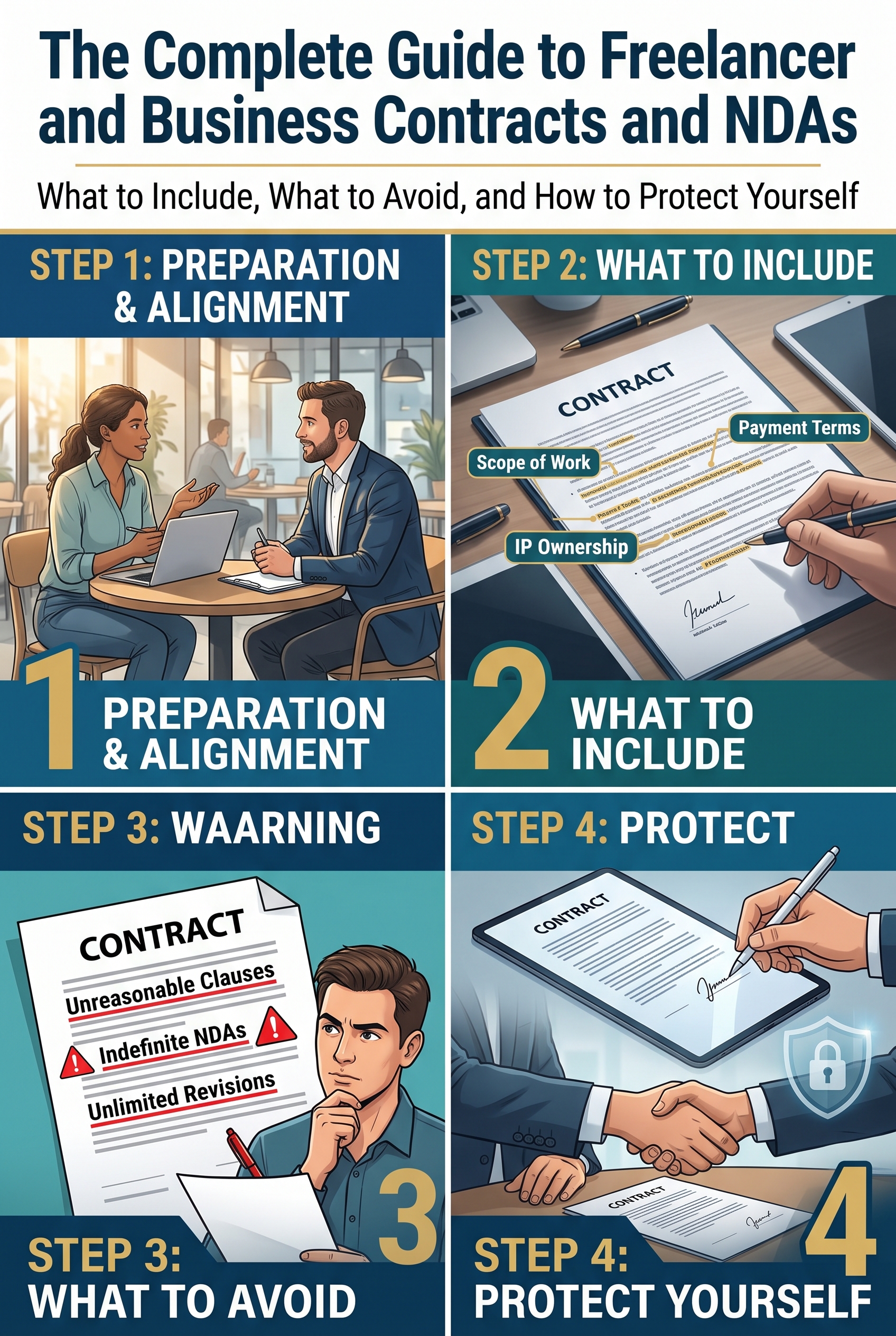
The Complete Guide to Freelancer and Business Contracts and NDAs What to Include, What to Avoid, and How to Protect Yourself Almost every freelancer or small business owner has a story about a project that went sideways. A client who disappeared after receiving the final files. A “quick revision” that turned into twelve rounds of changes. A payment that was promised “next week” for three months straight. Very often, these stories share one root cause: nothing was put in writing, or what was written was too vague to help. A good contract does not make you look distrustful. It does the opposite. It shows that you take the work seriously, that you respect the other person’s time and money, and that you would rather solve problems on paper than in an argument. A well-drafted non-disclosure agreement (NDA) does something similar for sensitive information: it tells everyone involved what must stay private and what happens if it does not. This guide explains, in plain language, how freelancer contracts, business service agreements and NDAs work. You will learn what makes an agreement valid, which clauses really matter, which mistakes cause the most trouble, and how to draft and sign documents with confidence. Whether you are a first-time freelancer, a small agency owner or a business hiring outside help, you should finish this article knowing exactly what to look for. Note: This article is for general educational purposes. Contract law differs from country to country and even from region to region, so it is not a substitute for advice from a qualified lawyer in your area. Why a Written Contract Matters More Than You Think Many people believe a handshake or a friendly email thread is enough, especially when working with someone they like. In practice, friendly relationships are exactly where misunderstandings hide, because nobody wants to awkwardly ask the hard questions up front. A written contract does four jobs at once. It creates a shared understanding. When you and a client describe the same project in your heads, the two descriptions are rarely identical. One person imagines a five-page website, the other imagines fifteen. Writing the scope down forces both sides to compare their expectations before any work begins. It protects your payment. A contract states how much you will be paid, when, and in what way. If a client later refuses to pay, a signed agreement is the strongest evidence you can bring to a conversation, a mediator or a court. It protects your ideas and your reputation. Clauses about ownership, credit and confidentiality make clear who can use the finished work and what each party may say about the other. It gives you an exit plan. Projects get cancelled, businesses change direction and people fall out. A termination clause explains how to end the relationship fairly, what happens to unfinished work and who owes what. Think of a contract as a map drawn before a journey. You hope you will never need to consult it urgently, but if the road gets rough, you will be very glad it exists. The Building Blocks: What Makes a Contract Valid? You do not need fancy language to make an agreement legally meaningful. In most legal systems, a contract has a handful of basic ingredients. Offer and acceptance. One party proposes terms (“I will design your logo for this price”) and the other agrees to them. Acceptance must match the offer. If the client replies “yes, but I want the source files too,” that is a counter-offer, not acceptance, and the discussion continues. Consideration. Each side gives something of value. Usually that means services in exchange for money, but it can also be goods, rights or other promises. An agreement where only one side gives anything is generally harder to enforce. Intention to create legal relations. Both sides must understand that they are making a binding commitment, not just chatting about possibilities. A phrase like “this agreement is legally binding” helps remove doubt. Capacity. The people involved must be legally able to enter contracts. Usually this means being of legal age and of sound mind. If you are signing for a company, you must have authority to bind that company. Legality. The purpose of the contract must be lawful. An agreement to do something illegal is unenforceable, no matter how carefully it is written. Clarity. Courts generally struggle to enforce terms that are hopelessly vague. A sentence such as “the freelancer will deliver good work soon” gives a judge almost nothing to measure. “The freelancer will deliver five finished blog articles of approximately 1,200 words each by 30 June” does. Many places also accept electronic signatures and agreements made by email or online forms, as long as the basic ingredients are present and both sides clearly agreed. Still, always check the rules where you and your client are based, especially for contracts involving property, long-term commitments or large sums. Anatomy of a Strong Freelancer Contract Most good freelance agreements are built from the same set of clauses. You can adjust the wording for your trade, but the topics below are worth covering almost every time. The Parties Start by identifying exactly who is making the agreement. Include full legal names, business names if relevant, addresses and contact details. This sounds basic, but it matters. If your client says “ABC Marketing” but the legal company is “ABC Marketing Solutions Limited,” you need to know which one is responsible for paying you. If you operate as a sole proprietor, use your own name. If you have a registered company, use that. Being consistent protects you in invoices, tax records and disputes. Scope of Work This is the heart of the contract, and it is where most conflicts begin. Describe in specific terms what you will do. List the services, the deliverables and the formats. For a web developer, that might include the number of pages, required features, browsers or devices supported and whether content entry is included. For a writer, it could be the number